KiwiSaver
FAQs
What is KiwiSaver?
KiwiSaver is a work-based savings initiative designed to help you prepare financially for your retirement. While you and your employer contribute to your savings, the Government also provides a number of benefits that make KiwiSaver a worthwhile investment for virtually every New Zealander.
Choosing to save into a KiwiSaver scheme is an important financial decision. Government and employer KiwiSaver contributions will help you build your retirement wealth. By participating in KiwiSaver, you can take charge of your financial future.
The key is to choose a KiwiSaver scheme that is tailored to your personal situation. We know there are many KiwiSaver schemes to choose from and you can invest in only one. We have developed a KiwiSaver scheme that has a number of attributes to attract discerning investors like you.
The benefits of KiwiSaver build up from day one. The earlier you start, the sooner you can start building your retirement wealth.
Further information on the NZ Funds KiwiSaver Scheme is contained in the current Product Disclosure Statement which may be downloaded here. A copy is also available on request by contacting NZ Funds.
Latest KiwiSaver changes and legislative updates.
KiwiSaver Contribution Changes from 1 April 2026
From 1 April 2026, KiwiSaver employee contribution rates are 3.5%, 4%, 6%, 8%, or 10% of before-tax salary, with 3.5% as the default rate. You can change your contribution rate once every 92 days. You can also apply for a temporary rate reduction to 3% for between 3 and 12 months. Your contributions will be reset to the default rate after 12 months. You can apply for the rate reduction as many times as you like.
KiwiSaver employer contributions will also increase from 3% to 3.5% of an employee’s gross pay (unless you have elected a temporary rete reduction, in which case your employer can choose to reduce their contribution to match your temporary rate reduction). Employers are legally required to contribute this amount for staff aged 16 to 64 who contribute.
What are the benefits of joining KiwiSaver?
Government contributions
Members may be entitled to a Government contribution (formerly called Member Tax Credits) of up to $260.72 pa. In order to qualify for the full amount, you need to be aged 16 or over and less than the Qualifying Age (currently 65), contribute approximately $20 per week (or a total of at least $1,040 per year) and meet certain other requirements.
Employer contributions
If you are an employed New Zealander, your employer is required to contribute a minimum of 3% (less tax) of your gross pay directly into your KiwiSaver account. As long as you are contributing, and between the ages of 16-65, your employer will make these contributions. As at 1 April 2026 the minimum employer contribution is 3.5% and it will increase to 4.0% from 1 April 2028.
For self-employed or not employed New Zealanders: If you are self-employed or not employed, you need to decide how much you want to contribute. If you contribute approximately $20 per week (or a total of at least $1,040 per year) you may qualify for the (annual) Government contribution.
Employee contributions
If you are employed, contributions will be deducted directly from your gross pay and invested in your KiwiSaver account. You can choose to contribute at a rate of 3%, 3.5%, 4%, 6%, 8% or 10% of your gross pay. If you do not choose a rate, your employer will deduct 3.5% from April 2026 and it will increase to 4.0% from 1 April 2028.
First home assistance
If you qualify, you may be able to withdraw funds from KiwiSaver for the purpose of buying a first home.
Who can join KiwiSaver?
Regardless of whether you are employed, self-employed or not employed, you can join KiwiSaver if you:
- are a New Zealand citizen or you are entitled to be in New Zealand indefinitely
- live, or normally live, in New Zealand (with some exceptions) or
- have not reached the age of eligibility for New Zealand Superannuation (currently 65)
From 1 July 2019, you no longer need to be under the age of eligibility for New Zealand Superannuation (currently 65) to join KiwiSaver, so long as you meet the other eligibility criteria above.
What is the Government contribution and how does it work?
To help you save, the Government will make an annual contribution towards your KiwiSaver account as long as you are a contributing member between the age of 16 and 65 years, until you earn more than $180,000 of taxable income per year.
The maximum annual Government contribution you are entitled to is $260.72.
To get the full Government contribution automatically, you have to contribute at least $1,042.86 a year. Employer contributions and Government contributions do not count towards eligibility for this credit.
The Government pays 25 cents for every dollar of member contributions annually (1 July to 30 June) up to a maximum payment of $260.72. This means that you must contribute $1,042.86 annually to qualify for the maximum payment of $260.72.
If you contribute less than $1,042.86 from your pay, you can make voluntary contributions to ensure you receive the full contribution from the Government.
If you contribute less than the full amount, you will receive a Government contribution that is proportionate to your contribution.
Who is eligible for Government contributions?
The Government contribution will be paid each year (around July/August) to members of a KiwiSaver scheme until you are eligible to withdraw your savings, provided you are 16 or over, and live (or normally live) in New Zealand (subject to some exceptions)
Joining KiwiSaver or turning 16 part-way through a year
If you join KiwiSaver part-way through a year (1 July to 30 June), you’ll receive a Government contribution based on the number of days in the year you’ve been a member.
Similarly, if you turn 16 during the year (1 July to 30 June), you’ll receive a Government contribution based on the number of days in the year that you are 16.
What happens to Government contributions when you turn 65?
Once you turn 65, if you have been in KiwiSaver for more than five years your entitlement to Government contributions ceases. If you have not been in KiwiSaver for five years by the time you turn 65, then your entitlement to Government contributions will continue until you have been in for five years. In order to receive these Government contributions in this case you will need to contribute the required minimum of $1,042 into your KiwiSaver account.
When are Government contributions paid?
We will claim the Government contribution on your behalf after 1 July each year. You do not have to do anything. Your Government contribution will appear in your KiwiSaver account within a month of us having made the claim.
How do I use KiwiSaver to purchase my first home?
First home purchase
You can apply to withdraw some of your investment to purchase a first home in New Zealand if you meet all of the following criteria:
- you have belonged or contributed to a KiwiSaver scheme or complying superannuation fund for at least three years
- the property you intend to purchase is, or is intended to be, your principal place of residence
- you have never held an ‘estate in land’ and you have not made a withdrawal from a KiwiSaver scheme for the purchase of a first home before.
Under the KiwiSaver Rules, members must leave a minimum of $1000 in their KiwiSaver account after the withdrawal and any funds transferred from an Australian complying superannuation fund cannot be withdrawn as part of a first home withdrawal.
If you would like to enquire about applying for a first home withdrawal from the NZ Funds KiwiSaver Scheme, please contact your Financial Adviser or email MUFG Pension & Market Services, the Administration Manager, at [email protected] or phone 0800 NZF KIWI (0800 693 5494).
Second chance withdrawal
In some circumstances, if you have previously owned a house or land you may still be eligible to withdraw your KiwiSaver savings as a second chance withdrawal. To qualify, you have to satisfy the Kainga Ora criteria. You will need to make an initial application to Kainga Ora, including details of your income and any assets or liabilities.
For more information, visit the Kainga Ora website at kaingaora.govt.nz/home-ownership/
What are the rules about first home withdrawals if a trust is involved?
If a member is buying their first home through a trust of which they are a trustee then, provided they personally meet the first home withdrawal criteria (that is, have been in KiwiSaver for three years, have not previously made a first home withdrawal, the home is going to be their principal family home, and they have not previously owned an interest in land), they can make a first home withdrawal and the trust can use the money for the purchase of the home. The member as trustee will need to be named on the Sale and Purchase Agreement.
If a member is the trustee of a trust that owns a property, then that member can make a first home withdrawal (even though they legally own an interest in land as a trustee) for the purchase of their own first home, provided that they have no reasonable expectation of occupying the property owned by the trust until the death of the current occupier or their survivor. Put simply, if you are not the occupier of the property owned by the trust then you are not considered to own it for the purposes of the first home withdrawal rules.
If a member is only a settlor or beneficiary of a trust that owns a property (and not a trustee of that trust), the trust is irrelevant and the normal first home withdrawal criteria apply.
How do I make a withdrawal for significant financial hardship?
Access to your KiwiSaver savings is governed by law. To be eligible for a significant financial hardship withdrawal, you must be able to demonstrate that you are currently, or likely to be, in at least one of the following situations:
- you are unable to meet minimum living expenses;
- you are unable to meet mortgage repayments on your family home, and the mortgagee is taking steps to enforce the mortgage;
- you need to modify your home to meet special needs arising from a disability affecting you or a dependant;
- you are unable to pay for medical treatment for an illness or injury affecting you or a dependant;
- you have incurred funeral costs for a dependant;
- you have incurred palliative care costs for you or a dependant; or
- you are suffering from a serious illness.
Click here for more information or to start the process.
How do I make a withdrawal for a life-shortening congenital condition?
You can make a retirement withdrawal at any time before age 65 under this category.
A life-shortening congenital condition is listed as a life-shortening congenital condition by the KiwiSaver Regulations which are:
- Down syndrome
- Cerebral palsy
- Huntington’s disease
- Fetal alcohol spectrum disorder
Or
exists for a person from the date of their birth and is likely to reduce the person’s life expectancy below the New Zealand superannuation qualification age.
Once you make a life-shortening congenital condition withdrawal, you will be deemed as having reached retirement age and the KiwiSaver retirement withdrawal rules will apply.
How do I make a withdrawal for a serious illness?
If you are seriously ill you can apply to withdraw all of your KiwiSaver savings.
You can make a serious illness application if you have an illness, injury or disability that:
- means you are totally and permanently unable to work in a job suited to your education, experience or training; or
- poses a serious risk of death in the short term.
How do I make withdrawals from my KiwiSaver when I retire?
When do you become eligible for KiwiSaver retirement withdrawals?
If you first join a KiwiSaver scheme on or after 1 July 2019, your Qualifying Age will usually be the age at which you become eligible for New Zealand Superannuation (currently 65). However, if you first joined a complying superannuation fund before that date (and then transfer to a KiwiSaver scheme from that fund) you must still meet the five year membership requirement.
From 1 April 2020, you can opt out of the five year membership requirement by notifying us (meaning that your Qualifying Age will then be the age at which you become eligible for New Zealand Superannuation (currently 65)). However, if you opt out, you will no longer be eligible to receive any Government contributions or compulsory employer contributions once you become eligible for New Zealand Superannuation.
From what starting date is the five years in KiwiSaver counted?
The five year qualification date means the earlier of:
- the date that is five years after the day on which you first became a member of a KiwiSaver scheme, or
- the date that is five years after the day on which the Commissioner of Inland Revenue received your first contribution for a KiwiSaver scheme.
What are your options once you reach eligibility age?
Once you reach the eligibility age you have three options:
- Do nothing. Just because you are eligible to access your KiwiSaver account doesn’t mean you have to! For many people, leaving their funds invested in KiwiSaver presents them with a highly diversified, cost effective retirement savings solution.
- Set up a regular withdrawal from your KiwiSaver account to supplement your New Zealand Superannuation or other retirement income sources.
- Access some or all of your funds when you need them.
Do you still qualify for the employer contributions?
No, you don’t qualify. However, if you keep on working your employer is able to make contributions if they wish to, but it is not compulsory.
Talk with your employer about this.
Do you still qualify for Government contributions?
No. Once you reach eligibility age you are no longer eligible for Government contributions.
Please note: In the year the member becomes eligible to withdraw they are entitled to the Government contributions for part of that year only.
How do you initiate a KiwiSaver withdrawal from the NZ Funds KiwiSaver Scheme?
Complete the Application for Withdrawal & Retirement Form. Once completed and signed by all parties (yourself and a Statutory Declaration witness), send, along with a copy of your photo ID to verify age, to:
Freepost NZ Funds KiwiSaver Scheme
Private Bag 92050
Victoria Street West
Auckland 1142
0800 693 5494 or (09) 362 9821 [email protected]
What is a statutory declaration and why is it required?
The KiwiSaver Act requires that a statutory declaration is completed by the member prior to withdrawing any Government contributions. A statutory declaration is a written statement declaring something to be true, and is made in the presence of an authorised witness.
This statutory declaration must be signed and dated in front of someone who has the authority to take statutory declarations and they must also sign to confirm that you have signed the declaration in front of them.
The witness for a statutory declaration must be one of the following:
- Member of Parliament
- Lawyer
- Justice of the Peace
- Registered Legal Executive (Fellow of NZILE) or
- Government Officer authorised to take statutory declarations
If you want to take out money on a regular basis, what are your options?
Minimum withdrawal amounts:
- Regular withdrawals – $100 per withdrawal (for weekly, fortnightly and monthly withdrawals).
- Ad-hoc withdrawals – $500 minimum lump sum (paid within two days after receipt of correctly completed documentation).
When will these withdrawals be paid?
Weekly and fortnightly withdrawals will be paid on Tuesdays.
Monthly withdrawals will be made on the 15th of each month (or prior working day if the 15th falls on the weekend or public holiday).
Full withdrawals – once a full withdrawal form has been submitted it may take up to four weeks before funds are deposited. Part of the process involved with a full withdrawal includes requesting and receiving the member’s final Government contributions from the IRD.
Can you frequently change the amount of the regular withdrawals from the NZ Funds KiwiSaver Scheme?
The purpose of a regular withdrawal is to provide a stable ongoing payment to the member.
In order to change the amount of the regular withdrawal the member will have to complete a new withdrawal form and await the next process date.
Another (perhaps better) option would be for the member to request a lump sum (one-off) withdrawal which can be processed within two business days of receipt of a correctly filled in form.
Can you still make contributions to the NZ Funds KiwiSaver Scheme after you are eligible to withdraw?
Yes. You are able to make voluntary or employer deducted contributions after you reach eligibility age.
How is a withdrawal made in the event of death?
In the event of your death, your KiwiSaver funds become part of your estate,
including any other assets, like a home or bank accounts you might have.
If the total value of your estate is less than the prescribed amount (currently
$15,000) and other conditions are met, we can pay your KiwiSaver balance
directly to a person allowed by law to receive it. This could be a surviving spouse or partner.
If the total value of your estate is over $15,000, your executor (the person named in your will to manage your estate) will need to apply for Probate before we can release the funds to your estate. If you die without a will, the person administering your estate will need to apply for Letters of Administration before we can release the funds to your estate.
Can I temporarily suspend contributions to my account?
If you are an employee, you can choose to pause your KiwiSaver savings by
applying for what is called a ‘savings suspension’. Generally you can only take
a savings suspension after one year of membership. A savings suspension can
last up to a maximum of 12 months, and there is no limit on the number of saving suspensions allowed.
What do I get for the fees I pay NZ Funds?
Investment
You get access to a diversified range of assets and global investment managers.
Your KiwiSaver Strategies have a downside mitigation overlay in place which means we aim to dampen falls in the value of your KiwiSaver balance when investment markets drop significantly in value.
You have a range of choices to achieve your long-term retirement savings goals:
- Life Cycle – your investment is automatically allocated across the three Strategies each year based on your age.
- Self Select – you can customise your own asset allocation to suit your needs.
- Alternatively, our Balanced Fund has zero management fees for members who are fee-conscious.
NZ Funds rebates all fund fees, charges and expenses annually, incurred by members under the age of 18.
No matter what asset allocation you choose, your KiwiSaver Strategies are managed with a responsible investment approach.
Communications
We provide full transparency of the individual investments held by your KiwiSaver Strategies and this information can be found on our website.
You receive a monthly email providing an update on the previous month’s KiwiSaver Strategies’ performance, as well as any other investments you may have with us.
Every fortnight you will receive an emailed invitation to listen to our webinar, The Monday Call, when we interview business leaders, investors and innovators.
Member services
You can use our Digital Wallet app to view your daily balances, transaction information, and your investment returns since joining. You can also update your PIR and other personal details and view/download key documents (tax certificates etc) which are stored securely in your digital vault. Alternatively, you can access the same information by logging in to your acount via our website.
Our local call centre, or our Client Services team, are available to take your calls if you need help with your KiwiSaver investment.
Action Fees
NZ Funds does not charge any establishment, contribution, termination, withdrawal, switch or transfer fees.
In addition, we offer a free Australian Superannuation Transfer service, should this be applicable.
Advice
In addition to the services your fees cover, we help you access financial advisers from a nationwide network of firms that advise on KiwiSaver (advice fees may apply).
Our online KiwiSaver calculator allows you to see what your balance at retirement could be if you change your contribution rate, change your asset allocation or if your salary changes.
And our Risk360 tool, also on our website, lets you check your risk profile at any time.
How long can I expect my retirement to be, based on my age and gender?
On average we can expect to have a longer and healthier retirement.
Based on Statistics New Zealand’s (SNZ) Cohort Life tables, each new decade’s group of 65 year olds can expect, on average, to live between 1.5 and 2.0 years longer than those born 10 years earlier.
For example, if you are 45 today, presuming you reach 65, you can expect on average to live to 89 years if you are a male and 92 years if you are a female.
This graph shows the trend of the recent past and the near future average life expectancy for males and females, once they reach 65, based on SNZ data and our extrapolation of New Zealand’s life expectancy data.
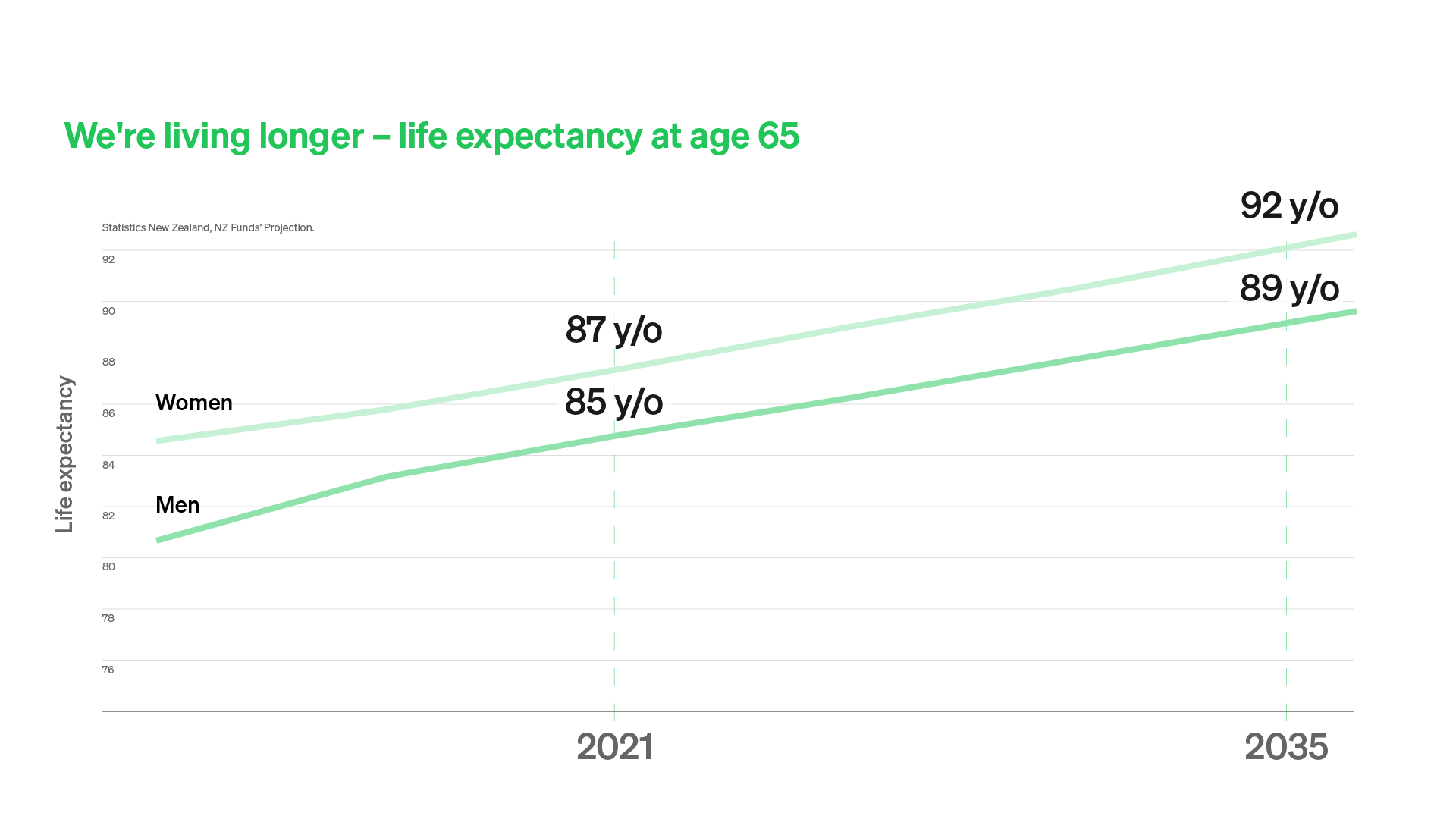
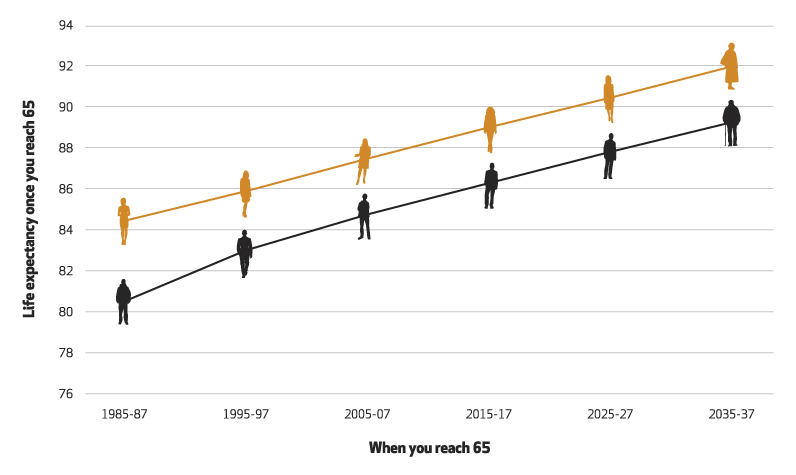
Source: Statistics New Zealand, NZ Funds’ projection. Life expectancy at age 65.
How do I make a one-off payment to my KiwiSaver account?
To make a contribution to your NZ Funds KiwiSaver Scheme, choose NZ Funds
KiwiSaver Scheme from your Internet Banking Payee list, and include:
Particulars: <Surname and initial>
Code: <NZ Funds KiwiSaver Scheme Member number – this number will
start with NZF>
Reference: <Member IRD Number>
To set up regular payments into your KiwiSaver account, download a direct debit form and send it to [email protected].
If you require any further assistance, please contact your financial adviser or the NZ Funds Client Services team on 0800 377 2277 or [email protected].
How much retirement money should I use at a time?
Before drawing down your retirement funds, we recommend discussing the options with your financial adviser.
Alternatively, contact our Client Services team on 0800 377 2277, and they can arrange for one of our advisers to call you.
You can find tips on drawing down your retirement funds here.
KiwiSaver Calculator
If you would like to use our KiwiSaver Calculator, click here.